
Back
Blogs
PAM’s purpose and the 2025/26 changes
With the 2025/26 NHS Premises Assurance Model submission deadline nearing and the shift from graded assurance to binary compliance dominating the conversation, it’s worth stepping back and asking a more basic question: what was PAM actually for in the first place?
Because once you answer that, the recent changes look less like a disruption and more like a course correction.
The original intent
The Premises Assurance Model was developed in partnership between the NHS and the Department of Health, and first released to the NHS acute sector on 1 April 2010, as a Microsoft Excel workbook [1]. The first formally published version followed on gov.uk in January 2013 [2], with revised editions in 2014 and 2016 [2][3]. The goal from the start was straightforward: give trusts a framework to self-assess their compliance, and make sure every organisation was thinking about all the aspects an NHS estate demands - not just the ones that happened to be front of mind.
It was never designed as a national performance management tool. The Department of Health’s own framing described it as a basis for assuring boards, patients, commissioners and regulators on the safety and suitability of estates [2]. In other words: a board assurance and improvement framework first, with national consistency as a secondary benefit. The early drivers were clear:
Give boards evidence that their estates were safe. A board owning a large, critical estate needs more than reassurance, it needs a structured basis for confidence.
Support consistent governance through a period of major structural reform. The NHS of the early 2010s was reorganising around trusts and boards; a common framework kept estates governance coherent while everything around it changed.
Improve investment decisions. The logic was simple: if a trust understands where its biggest assurance gaps are, it can prioritise capital and maintenance spend where it matters most.
That founding question - how can a board know, with confidence, that its estate is safe, effective, and being managed appropriately? - is exactly the question we built CompliMind to answer. It’s why PAM’s vision resonates so strongly with us.
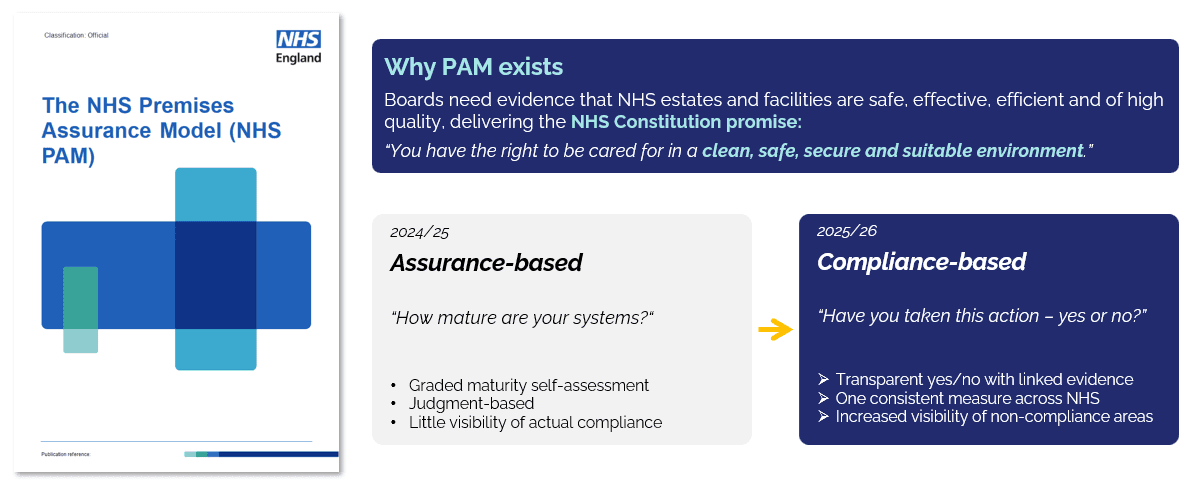
PAM exists to give boards evidence of a safe estate, and the redeveloped model replaces graded maturity self-assessment with transparent yes/no compliance questions linked to evidence.
The drift
Somewhere along the way, the way PAM was used drifted from that intent.
In recent years it became, for many trusts, an annual scramble: summers spent chasing documents, approximating whether evidence exists, and judging, often subjectively, how compliant it makes them. The graded scoring scale, with its amber middle ground, invited exactly this kind of approximation. The output was a return, not assurance.
The realisation at national level was honest: the evidence being produced wasn’t meeting the original intent. Trusts were creating months of work without creating real benefit.
The 2025/26 change: a tightening, not a departure
Seen in that light, the shift from an assurance-based model to a compliance-based one, with binary yes/no questions replacing the graded scale, tightens PAM back toward what it was always meant to do. NHS England itself has acknowledged the consequence: the 2025/26 collection will not offer a direct year-on-year comparison with 2024/25, even though most head questions have been kept consistent to preserve some form of continuity [4].
A binary question forces a real answer. Either the standard is met AND the evidence exists, or it doesn’t. There’s no amber to hide in, no room for a well-worded narrative to substitute for a well-managed estate. Yes, that means more red results in year one, NHS England has said as much [5], but red results that reflect reality are worth more to a board than amber results that reflect optimism.

Many trusts will see substantial non-compliance under the new model, even where nothing on the ground has changed, a function of removing the amber middle ground, not necessarily of estates getting worse.
What 2010 couldn’t do, and 2026 can
Back in 2010, an Excel workbook was simply the only mechanism available. The intent was a live, confident picture of estate safety but the technology could only deliver an annual snapshot, assembled by hand.
In 2026, that constraint has gone. In the age of AI, PAM can be so much closer to what it was always reaching for: a live digital assurance platform rather than an annual return:
Continuous evidence instead of a once-a-year self-assessment sprint.
Automated checks against legislation and policy as they change, not months later.
Live dashboards with full traceability from every answer back to its evidence.
Investment prioritised by compliance and patient safety risk, closing the loop on that original third driver.
Harmonisation across the NHS, so hundreds of trusts stop independently interpreting questions in light of their needs.
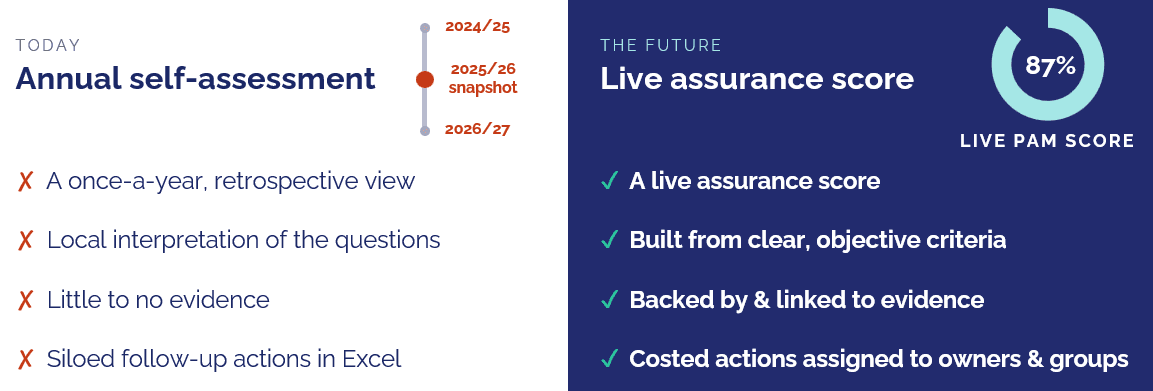
From an annual, retrospective snapshot to a live assurance score: objective criteria, evidence-linked answers, and costed actions assigned to owners and groups.
Back to the beginning
The 2025/26 changes aren’t a break with PAM’s history, they’re a return to its founding purpose, at exactly the moment the technology finally exists to deliver on it.
That’s the vision we’re building toward at CompliMind. With our new PAM module, we’re supporting trusts to make that move: out of the annual spreadsheet scramble, and into continuous, evidence-backed assurance that gives boards the confidence PAM promised them sixteen years ago.
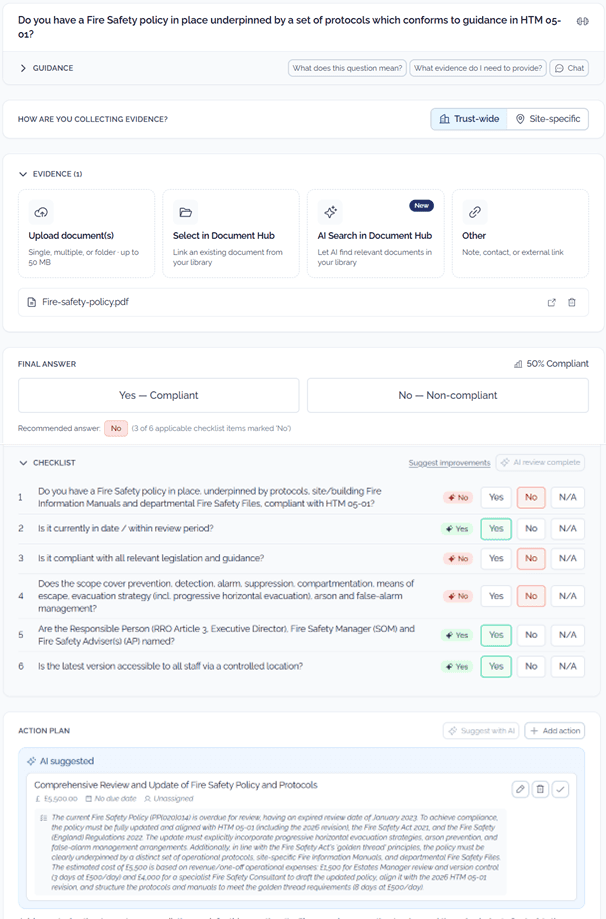
Inside the CompliMind PAM module: evidence is collected and reviewed against each question, and actions are drafted automatically based on the gaps identified.
References
Department of Health, Invitation to Tender: NHS Premises Assurance Model Metrics Update (2015)
Department of Health, NHS Premises Assurance Model (gov.uk publication, first published 24 January 2013; updated 2014 and 2016)
Department of Health, The NHS Premises Assurance Model - Revised and Updated 2016 (January 2016).
NHS England, The NHS Premises Assurance Model (guidance long-read, current edition) — notes that 2024/25 and 2025/26 will not be directly comparable year-on-year. england.nhs.uk
Simon Corben, Director and Head of Profession, NHS Estates and Facilities, NHS England - letter to trusts confirming the shift to compliance-based yes/no questions, the expectation of more red results in year one, and the submission deadline of Tuesday 8 September 2026. (Circulated to trusts; not published online at time of writing.)
NHS England, NHS Premises Assurance Model (estates guidance overview page). england.nhs.uk
NHS England, NHS Premises Assurance Model guidance 2023 (Version 1.2, April 2023) — the last full guidance edition under the graded, assurance-based model. england.nhs.uk